
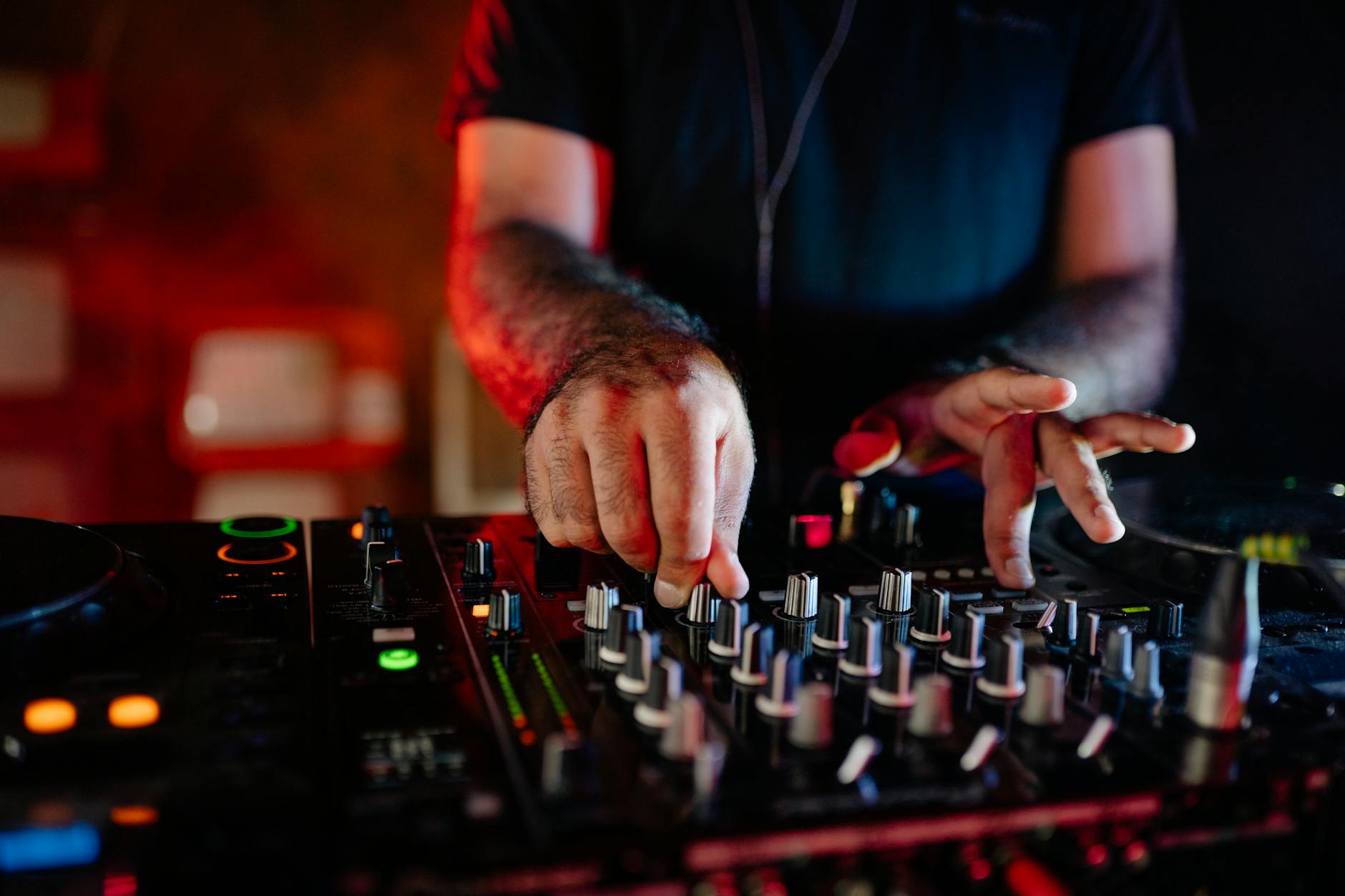
It's 4:30 AM at the after-party. A DJ who's been around since 2003 has a beer in each hand and is explaining to a 24-year-old why sync is killing the craft. The 24-year-old played a 200-person warm-up earlier that night. The 2003 DJ has not had a paid gig since 2019. Both of them are wrong about beat matching.
Here's what beat matching actually is in 2026, what's worth your time, and the skill that nobody at that after-party will mention — the one that separates a working DJ from a very loud hobbyist.
What beatmatching actually is
Beat matching is aligning two tracks so their kicks land on the same instant, played at the same tempo, for as long as you need them blended. That's it. Two tracks. One pulse. No swing. The mechanics get more interesting in a minute, but the definition fits on a coaster.
You can do it three ways: by ear (slowly, with practice), by visual aid (waveforms in Serato or Rekordbox), or by sync (the software does the math). All three produce the same audible result if executed correctly. Anyone telling you the audience hears a difference between a manually-matched mix and a synced one is selling you something — usually a course.
The reason people argue about which method counts as "real" DJing is the same reason guitarists argue about tube amps. It's about identity, not output. The dance floor doesn't care. (Wikipedia's beatmatching entry is a clean reference if you want the textbook version of the definition.)
BPM, pitch faders, jog wheels — the mechanics
BPM stands for beats per minute. Most house tracks live between 118 and 128 BPM. Hip-hop sits anywhere from 70 to 110. Drum & bass runs 170 to 180. Reggaeton lands around 88 to 105. If those ranges feel familiar, skip the next paragraph.
To beat match manually, you adjust the incoming track's tempo with the pitch fader (the long slider on a controller, CDJ, or in software) until its BPM matches what's already playing. Then you nudge the platter — the jog wheel on a CDJ-3000X or DDJ-FLX10, or click-and-drag on the waveform — to align the first kick of the new track with the next kick of the playing one. From there, the pitch fader keeps them locked. If you've matched both tempo and downbeat, you can crossfade.
That's the loop on every beat-matching tutorial ever written:
- Set the BPM with the pitch fader.
- Align the downbeat with the jog wheel.
- Ride the fader to keep them locked.
What changes between a CDJ-3000X ($2,999, released September 2025), an OPUS-QUAD, a DDJ-FLX10, and a $300 controller is how easy the hardware makes that loop — pitch fader resolution, jog wheel responsiveness, screen real estate — not the loop itself.
Cue points (the markers you set on each track to mark a useful intro or drop) make the alignment step faster. Set them once during prep, hit them in the booth. Most working DJs set 2 to 4 cue points per track and never touch the rest.
Sync isn't cheating. Bad track selection is.
Here's the position: in 2026, the sync button is a tool. Use it.
The argument against sync is that beat matching by ear builds your timing. Fine — build it on practice tracks at home. At a paying gig, your job is to read the room, queue the next track, work the EQ, take the bride's cousin's request, and not crash the train. Sync handles the tempo math while you handle the other six things.
Sync isn't replacing skill. It's freeing skill to land where the audience can hear it.
The DJs who still mock sync in 2026 are usually playing to twelve people in a back room while a 24-year-old with sync enabled has the main floor. That's not a coincidence. Manual beat matching used to be a gatekeeping skill because it had to be — the gear couldn't help. Now the gear can help. The skill moved up the stack.
What hasn't moved is track selection. The DJ who can't read the floor at 1:47 AM and pull the right track from a mental Rolodex of 100,000+ options is going to clear the floor whether their beats are matched by ear, by sync, or by séance. So spend the cognitive budget you used to spend on tempo math on knowing your library cold.
Phrase matching is the actual craft
This is where the after-party debate gets it wrong. The skill that separates a working DJ from a hobbyist isn't whether you sync your beats — it's whether you sync your phrases.
A phrase in 4/4 dance music is typically 16 or 32 bars. Tracks are built in those chunks: an intro phrase, a verse phrase, a build, a drop, a breakdown, an outro. When you blend two tracks, the magic isn't aligning kick #1 of song B with kick #N of song A — sync does that. The magic is aligning the end of song A's outro phrase with the start of song B's intro phrase, so the breakdown of A resolves into the build of B and the floor doesn't notice the seam.
Get this wrong and you get the awkward middle-of-a-verse crossfade, where the new track's vocal collides with the old one and the floor wakes up wondering what happened. Get it right and the next track was always playing — you just made it audible.
Beat matching is table stakes. Phrase matching is the craft.
Phrase matching is just counting to 32 without losing the plot. Open Serato 3.x, Rekordbox 7, or Traktor Pro 4 and you'll see the bar count tick by — most software lights up the downbeat, some draws phrase boundaries automatically. Use them. The hard part isn't reading the count; it's deciding which phrase boundary to use, in the moment, when the next track is queued and the current one is 16 bars from its outro.
Anticipating breakdowns is part of this — when you know song B has a soft 32-bar intro, you can ride song A's last drop confidently and start the blend on the breakdown. Blending genres is part of this too — a 122 BPM tech house phrase doesn't always pair with a 122 BPM trap phrase even when the tempos are technically matched. The structures fight. The trick is hearing where they don't.
A curated DJ pool with phrase-friendly edits and clean intros buys you a lot of this for free — the edits are built with phrase-aligned tools (8/16/32-bar intros, clean breakdowns) so the alignment work is easier in the booth. That's the working-DJ tax break the catalog companies don't talk about.
Key matching — the silent multiplier
Two tracks at the same BPM don't always blend. Two tracks in the same musical key blend even when their BPMs are slightly off. That's the trade-off behind harmonic mixing — selecting tracks that share, or musically relate to, each other's key.
The industry-standard notation for this is the Camelot wheel — a numbered system from 1A to 12B that maps musical keys onto a clock face. Tracks at the same Camelot number blend smoothly. Adjacent numbers (1A → 2A, or 1A → 1B) blend with a slight harmonic shift that often feels intentional. Skip more than one slot and the blend usually clashes.
Serato 3.x, Rekordbox 7, and Traktor Pro 4 all auto-detect key on import — the result is shown next to the BPM in the track list. The detection is good but not perfect; it'll sometimes nail the key for a clean studio track and miss on a noisy live recording. Trust it for ~90% of your tracks; trust your ear on the other ~10%.
When to break the harmonic rule: every time the floor wants energy more than it wants smoothness. A jarring key shift on a peak-time drop is a feature, not a bug — the audience hears it as escalation. So the working approach isn't "always mix in key." It's "mix in key by default, break it on purpose."
For DJs who want to dig deeper into how the wheel maps to the circle of fifths, Wikipedia has a clean reference. For day-to-day use, the auto-detected number on the track row is enough.
How do you practice beatmatching for paid gigs?
Most beat-matching tutorials are written for someone who'll never get paid to DJ. The advice ("practice for an hour a day", "match the same two tracks repeatedly") is technically correct and mostly useless once you're playing weddings, corporate events, or club residencies. Here's what helps when there's actually money on the line.
- Practice transitions you've never tried instead of transitions you've nailed. Repeating the same successful blend is comfort food. The skill grows when you're forced to handle a tempo jump, a key clash, or a genre swap on tracks you don't know well.
- Practice with the gear you'll play on. If your residency has CDJ-3000Xs, don't practice on a controller for two months and show up cold. The pitch fader resolution, the jog wheel feel, and the screen layout matter. Most clubs let you come in for a warm-up if you ask. Most don't, if you don't.
- Record every set. Listen back the next day with coffee and a notebook. Most of the mixes that felt clean in the booth aren't, and most of the ones you cringed at in real time are fine. The mismatch is your perception calibrating; the recording is your training data.
- Practice reading the floor more than the gear. Your beats can be perfectly matched and the wedding mom will still walk over at 11:47 PM to request "September" by Earth, Wind & Fire. Your job is to know that's coming, have the track keyed, and land it on the next phrase boundary so it feels intentional. The technical skills exist to serve that moment.
Frequently asked questions
Is beat matching by ear still worth learning in 2026?
Yes — but not for the reason most DJs say. The value isn't in being able to match beats without sync (sync is faster). The value is in training your ear to hear when two tracks are slightly off, which makes it obvious when sync mis-detects a BPM (it happens — usually on tracks with intros that confuse the analyzer). A trained ear catches the half-time/double-time misreads before they hit the speakers.
How long does it take to get good at beatmatching?
Manual beat matching: 10 to 20 hours of focused practice gets you reliable on standard 4/4 tracks at consistent BPMs. Add another 40+ hours to handle tempo changes, drops, and tracks with weird intros confidently. Phrase matching takes longer. Call it a year of working gigs, because it's pattern recognition at scale and you can't shortcut the rep count. Sync makes the first 10 hours unnecessary; you spend that budget on phrase matching instead.
Do I need a controller or can I learn on software only?
Software-only (Serato 3.x, Rekordbox 7, Traktor Pro 4 with mouse + keyboard) works for learning the concepts — BPM math, cue points, EQ, phrase counting. It does not prepare your hands for a controller or CDJ-3000X. The pitch fader, the jog wheel, and the EQ knobs all have physical resolutions and feel that screen drags don't replicate. If your goal is paid gigs on someone else's gear, get a controller as soon as you can — even a sub-$300 entry-level unit teaches your hands what software doesn't.
What's the difference between sync and beat matching?
Beat matching is the outcome — two tracks, same tempo, downbeats aligned. Sync is one method of getting there (software does the math). Manual is another method (you do the math). Hybrid is a third (manual tempo, sync-assisted alignment). The dance floor experiences the outcome, not the method. The professional debate is about identity; the audience debate doesn't exist.
More for working DJs on the Bangerz Army blog, or see what we built and why. Building the library those matched tracks live in? Read how to build a DJ music library that holds up at 1:47 AM.
Image credits. All photos via Pexels under the Pexels free-to-use licence. Hero: Yan Krukau. Inline 1: Ivan Mudruk. Inline 2: cottonbro studio. Inline 3: RDNE Stock project.